


Across the senior care industry, thousands of adult children each year face a baffling scenario: their aging parent has a minor slip onto a carpeted bedroom floor, completely unhurt, yet two hours later, they receive a call from a busy hospital Emergency Department. Why does an uninjured fall in corporate assisted living so frequently end up in a 911 dispatch?
The Midnight Phone Call Families Never Expect
When families move a parent into a modern assisted living facility with a polished lobby and hotel-style amenities, they assume they are purchasing round-the-clock safety and medical oversight. They expect that if their mother drops her reading glasses and slides off her chair onto a soft rug, a trained caregiver will step in, ensure she isn't hurt, and help her back to her feet.
Instead, thousands of families discover the reality only after receiving an unexpected ambulance bill or an urgent call from an ER triage nurse.
Inside many 100+ bed corporate facilities, a hidden policy governs daily operations: The Mandatory "No-Lift" Rule.
What Is the Corporate "No-Lift Policy"?
In mega-facilities housing 80 to 150 residents, caregiver-to-resident ratios frequently stretch to 1:15 or even 1:20 during day shifts, and worsen overnight. To protect staff from occupational back injuries and shield corporate owners from workers' compensation claims and legal liability, corporate executives enforce strict "No-Lift" guidelines.
Under these rules, direct care aides are contractually forbidden from manually lifting or assisting a resident off the floor, regardless of whether the resident is in pain or completely uninjured.
When a resident experiences a non-emergent slip, staff cannot physically intervene. Instead, their protocol requires them to immediately dial 911 for a municipal "Lift Assist."
"My mother slid off her bed onto the carpet at 2:00 AM. She was completely fine, talking, and laughing. But the aides told me facility policy prohibited them from touching her on the floor. They called 911. The paramedics insisted on transporting her to the ER 'just to sign off on liability.' She spent 11 hours on a gurney."
Member,r/AgingParentsCommunity
"Facilities use 911 as a free staffing fallback. If they don't have enough staff or physical therapists on site to perform a safe two-person transfer, they call the local fire department. It’s an open secret in senior care."
Healthcare Advocate,r/CaregiverSupport
When paramedics arrive for a lift assist, they are legally obligated to evaluate the senior. To protect themselves from liability, first responders routinely urge families or residents to accept ambulance transport to the Emergency Room for a "precautionary check."
The Hidden Trauma: Hospital-Induced Delirium
While sending a senior to the ER "just to be safe" sounds prudent on paper, in geriatric medicine, an unnecessary emergency room visit is often catastrophic.
For an older adult, especially one living with mild cognitive impairment, vascular dementia, or Parkinson's, the ER environment is a sensory assault. Bright fluorescent lights 24 hours a day, blaring telemetry monitors, unfamiliar voices, blood draws, and hours lying on a hard transport stretcher disrupt the brain's fragile baseline.
This severe disorientation triggers Acute Hospital Delirium.
"My dad went into the hospital walking with a cane after a minor slip. After 14 hours in the ER under bright lights and getting an IV he didn't need, hospital delirium set in. He became terrified, pulled at his IVs, and stopped recognizing us. By day three, they put him in a wheelchair because his legs had completely deconditioned."
Adult Daughter,r/dementiaCommunity
"Hospital delirium isn't just temporary confusion. It accelerates cognitive decline by months or years, and the forced bed rest causes immediate muscle wasting in 80-year-olds."
Geriatric Nurse,r/CaregiverSupport
The Downward Spiral of an Unnecessary ER Visit:
- The Slip: Senior slides uninjured to the floor in their room.
- The 911 Call: Understaffed aides follow the "No-Lift" rule and dial emergency services.
- The ER Transport: Paramedics transport the senior to the hospital for liability sign-off.
- Delirium & Restraints: Fluorescent lights and noise trigger acute confusion and agitation.
- Deconditioning: Hours tied to a hospital bed weaken leg quadriceps and core balance.
- Loss of Mobility: The senior returns to the facility unable to walk independently, often forced into a wheelchair permanently.
Comparison: Emergency Response & Fall Management
The difference between corporate facility management and clinical micro-home care comes down to who is evaluating a senior on the ground.
Fall Protocol & Emergency Care Comparison
| Care Protocol | 100+ Bed Corporate Facility | Physical Therapist-Led Home (1:4 Ratio) |
|---|---|---|
| Uninjured Slip Protocol | Automatic 911 Call ("No-Lift Rule") | On-Site Clinical Vitals & Range of Motion Check |
| On-Site Assessor | Entry-Level Care Aide (1:15 ratio) | Physical Therapy Clinician & 1:4 Care Staff |
| Transfer Technique | Wait for Municipal Paramedics | Biomechanical Manual or Mechanical Assist |
| Hospital Delirium Risk | High (Frequent ER Ping-Ponging) | Minimized (Emergency 911 for True Trauma Only) |
| Post-Fall Action | Generic Administrative Incident Report | Root Cause Gait, Footwear & Medication Analysis |
How Physical Therapist-Led Care Homes Break the Cycle
In specialized, physical therapist-led residential care homes operating with low caregiver-to-resident ratios (such as 1:4), care is structured around clinical assessment rather than administrative liability.
When a resident experiences a loss of balance or slips:
- Immediate Clinical Assessment: Rather than panicking or filling out generic forms, trained caregivers and physical therapy staff perform an immediate on-site clinical evaluation. They check orthostatic vital signs, pupil reactivity, range of motion, and pain sensation.
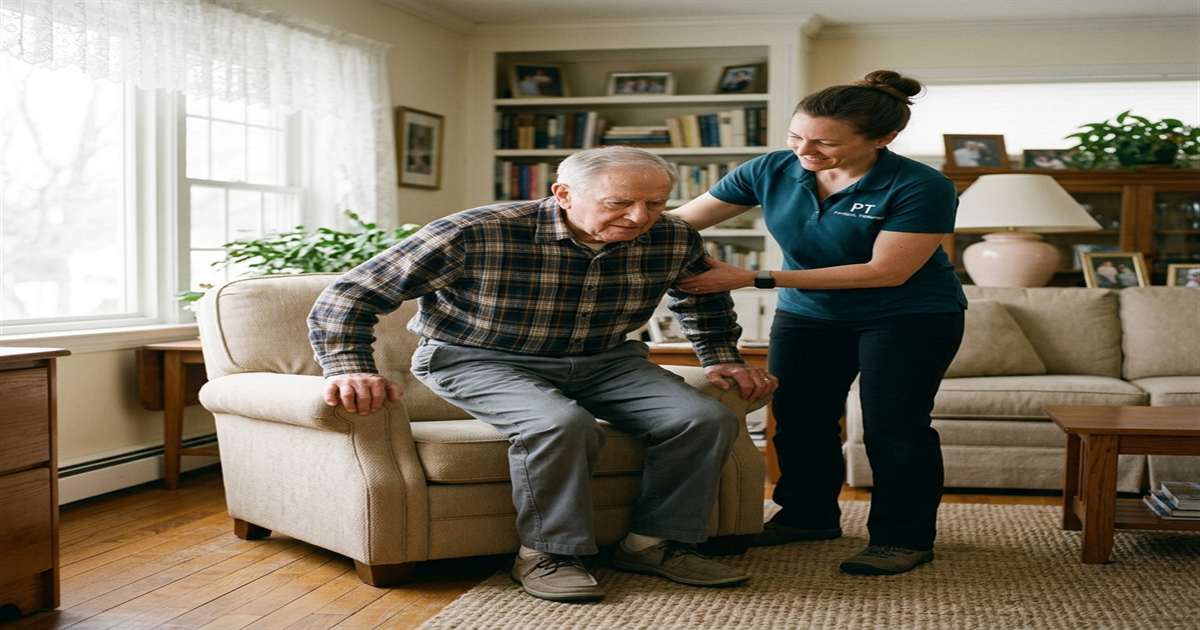
- Safe In-House Transfer: If the resident is uninjured, staff use proper physical therapy transfer techniques (gait belts, slide boards, or mechanical sit-to-stand lifts) to assist them back to a chair or bed in a calm and dignified way, without dialing 911.
- True Emergencies Handled Instantly: If there is any suspicion of head trauma, severe pain, or vital instability, emergency medical services are dispatched immediately. But 911 is reserved for genuine medical emergencies, not as a substitute for adequate staffing.
- Root Cause Rehabilitation: Following any loss of balance, physical therapy clinicians conduct a movement analysis. Was the fall caused by blood pressure drops upon standing? Improper footwear? A change in medication? The care plan is adjusted immediately to address the root physical cause.
4 Questions Families Should Ask When Touring Assisted Living
If you are currently evaluating senior living options for an aging parent, do not rely solely on lobby aesthetics. Ask these four operational questions:
- "What is your exact facility policy if my parent slips to the floor and states they are uninjured?"
Red Flag: "We call 911 for all falls regardless of injury status." - "Are your direct care aides permitted to perform manual or mechanical lift assists?"
Red Flag: "Our aides operate under a strict no-lift policy." - "What is your caregiver-to-resident ratio during night shifts?"
Red Flag: Anything higher than 1:8 in assisted living or memory care. - "Who conducts the clinical evaluation before deciding whether to call an ambulance?"
Red Flag: "The floor shift supervisor fills out a form and calls 911."
Protecting Long-Term Dignity and Mobility
Assisted living should protect a senior's safety, not subject them to corporate liability rules that trigger unnecessary hospital trauma. Understanding facility fall protocols, staffing ratios, and clinical oversight empowers families to make informed choices that preserve their loved one's independence and peace of mind.
To learn more about clinical oversight in senior residential environments, read our guide on The Physical Therapist-Owned Care Home Advantage.